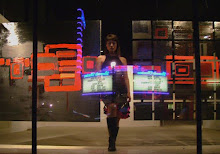
Just been invited by the 7th BERLIN BIENNALE FOR CONTEMPORARY ARTS 2012
to participate in ArtWiki: Open Data for the Arts. ArtWiki builds upon the principles of the Open Web applied to the art world.

March 09, 2012


February 13, 2012

February 04, 2012

January 05, 2012

October 12, 2011
February 10, 2011
OPENING RECEPTION 'Driven to Abstraction; My Bloody Black Valentine'
February 10th, 2011 5-10PM
GLORIA DELSON CONTEMPORARY ARTS
215 W. 6th Street #115
Los Angeles, CA 90014
Los Angeles, CA 90014
Link to VIDEO http://www.gloriadelsoncontemporaryarts.com/Events/events.html
Artists Statement for 'Driven to Abstraction / THE MEMORY PALACE SERIES' by Birgitte Moos
Since the early 80’s neo-expressionism, painting was in the latter part of the same decade declaired, dead. In Europe the movement was labelled ’The New Wild Ones’ and in the US either ’Punk Art’ or 'Bad Painting’. Later, in New York, neo-expressionism influenced graffiti art, exemplified by Jean-Michel Basquiat. 'Bad Painting,’ opposed the idea of a piece of art as an unique 'accessoire' for the bourgeois circles. Neo-expressionist painters typically commented on the isolation of man and alienation created by modern society. The paintings were often aggressive and 'ugly'. A response of protest and despair and pure simulated confusion.
Bad Painting, rejected 'good taste!' I personally do not reject ’good taste!’ I do not believe there are such fixed definitions as good taste anymore. The contemporary world consists of, sliding outside the concepts of nationality and presupposed identity politics. A decentered world without fixed signifiers and national symbolic forms.
If 'new painting’ are seen in a broader perspective than the meaning of policy, they can be interpreted with far more complexity through an angle which shows, that we live in an era where global cultural signs and codes are constantly available, especially in a universal software supermarket inside the computer. Receivers may even according to John R. Hall be so international that they cannot identify with visual stereotypes recognized by a homogeneous group. I guess the same counts for the Artists.
These are some of the challenges which painting is facing today. One way to gain insight into the paradox, is to be updated and aware of visual communication, and that artists study linguistics. In that field, cognitive linguistics is highly relevant to explain how paintings, through visual metaphors, can make the complex understandable.
My task has been to re-examine the style of neo-expressionism, and as a female artist from a younger generation, to respond to an art movement dominated by male artists.
My approach to form is painting formless forms, reminiscent of decorations that indicate a subliminal sense of an underlying threat: The newer hyper-globalized landscape incorporating references that no longer have specific cultural reference points. I find this landscape extremely fascinating, and a new infinite ground for creating hybrid forms of visual expression.
The question is, how to integrate these opportunities into an ’altmodisch’ medium such as painting?
My perspective is spatial negotiation and traces of thought. An interdisciplinary approach to painting, where the painting should not be a piece of an art installation but an installation of art. Painting becomes a performative act more than a finished art-business object. Its content is depth in the surface and style in its substance.
The content of the painting is temporal. Its content visualizes what time is, in itself, when it is created as a physical and abstract object, the painting. The object itself is a container containing time. The painting is incomprehensible from the inside, giving the outside audience an experience beyond time and space. The painting has transformed time into an object, where the object is subject to the spectator attendance.
When a spectator places himself in front of a painting, the person is in time. Inside the painting many time periods are reflected. Regarding the time reflections, I took a starting point from Jaques Lacan’s theories of ’Mirror Stages’. A human is in ’violence of time’. The experience inside the container becomes self-referential. The sequences of events (the visual compositions) that are inside in time (present, space, sound) are variant and multi referential.
When a spectator places himself in front of a painting, the person is in time. Inside the painting many time periods are reflected. Regarding the time reflections, I took a starting point from Jaques Lacan’s theories of ’Mirror Stages’. A human is in ’violence of time’. The experience inside the container becomes self-referential. The sequences of events (the visual compositions) that are inside in time (present, space, sound) are variant and multi referential.
I adapted some of my considerations about time from an object ’Alt 2000’ that I developed while being a student of set design at Denmarks Designschool.
I take a lot of pleasure in making the painting seem like there is a lot of work beneath the paint, to it give it the feel and texture of a worked-on canvas. But, as the surface is the content, it becomes alive straight away. I have no need to spend months on generating one single expression as on a naturalistic painting. This can be be done swiftly through other medias.
On the contrary, the act of painting is an action where the body pulls on impressions of layered information, gathered through being an image devourer, and an avid reader fascinated by intercultural expression. The impressions need to be transferred to the canvas quickly, so I can move on with my research and paint more paintings.
I don’t search for my identity through the act of painting anymore, and rarely, if ever, paint as a need for emotional or immediate expression or relief, as seen in the postwar expressionist movement. Works coming out of various influences are translated into precise abstractions containing shape, form, color and opinions about culture. Multiplying the newer cultural diffences and inserting old values in the 'semiotic square'.
As the paintings deals with multi-referential forms, they can be decoded in several directions. Inspirational sources can include anything from art, new technology to the humanities such as anthropology, philosophy, art history and linguistics to social and natural sciences.
Intuitively my intention is to create experiences of a coincidence principle. A principle of perfection through 'de-form' where the known and the aesthetic material is broken up. I have for example been inspired by the title of Deleuze and Guattaris’ ‘A Thousand Plateaus: Capitalism and Schizophrenia'.
The paintings are references to various movements, past and present.
I choose to work so fast that I cannot stop the content from becoming a response to my own myriad of thought contradictions and interests, as a result of being a product of an era, that is and has developed so quickly as never seen before in history.
My guess is that, the brain has so much unused capacity and empty space, that it can afford to take in lots of new information and reprocess it.
Being classically trained, and been dragged through years of art theory and drawing through the various educational instititutions, this has helped me to place paint precisely abstract. Sort of abstract figurative. To paint without indecisiveness, because of the personal, ethical and aesthetic foundations within me.
Not as a result of toxic oil fumes, I assure you, as I do use acrylic paint, I simply love color and the process of mixing them,
it is highly intoxicating. But I do question the defense of ancestral academic virtues and crafts. Today, it is completely different floating values, it's about. Art has become an open expression that freely chooses its materials and techniques as needed.
I don't see breaking up the use of styles as a postmodern stylization. I see it as standing on the edge of post-human society’s stylization. I am influenced by being a witness of unprecedented technologies introduced to extend and enhance human living conditions.
Humanity is in the intermediate stage of a new system, which question previous centuries of humanistic values and traditions. Some scientists believe that we are now on the threshold of new forms of existence and interaction. Changes that which no doubt will transform basic human living conditions. These changes will provoke very deep ideas in the humanistic sciences: The past inventories of cultural material that has taught us about the humanistic values. The Australian Artist Stellarc states, that new modes of high-tech interaction could break cultural memory and the old ways of Western thinking. This scenario would have been a relevant solution to Hamlets schism; a mankind still functioning on memory.
Humanity is in the intermediate stage of a new system, which question previous centuries of humanistic values and traditions. Some scientists believe that we are now on the threshold of new forms of existence and interaction. Changes that which no doubt will transform basic human living conditions. These changes will provoke very deep ideas in the humanistic sciences: The past inventories of cultural material that has taught us about the humanistic values. The Australian Artist Stellarc states, that new modes of high-tech interaction could break cultural memory and the old ways of Western thinking. This scenario would have been a relevant solution to Hamlets schism; a mankind still functioning on memory.
I am not on a mission to neglect humanistic traditions and values . On the contrary, the experiment is an attempt to find new painterly forms and to explore how the painting has its eligibility, and why!
I have in a constant interaction explored and worked with painting, new visual forms of communication, digital media, interdisciplinary set designs, graphics and fashion. And return passionately back to expressive painting, as the most direct medium to express a network of content and codes, that I constantly seek out and meet in my everyday life. An everyday, where I try to avoid the tedium and ignorance. A life composed of choices and involuntary events, where the multiple forms of media is not above, but a foundation for painting.
A painting can both inspire and be inspired by intercultural communication. Simultaneously a new cultural landscape emerges: a mutually synergistic interaction communicating between the surrounding society, paintings and viewers.
Overall I assume that my paintings consists of consciousness, sociological reflections, cultural commentary and memory, collective work across disciplines, applied interdisciplinary art forms and transformations of words and action into spatial painterly solutions. Painting contains an option to move people's awareness, support the development of global networks, transcend age, experience, social, religious and cultural backgrounds.
January 06, 2011
JANUARY 2011 EXHIBITION
Caporale/Bleicher Gallery
355 N La Brea Ave, LA. Installation-curatorial hybrid by Airom Bleicher, with
collaborating artists.
Anachronious Mind Tree is a dynamic constantly evolving
exhibit and simulation of a connectionist network (the
computer programing used in Artificial Intelligence
modeling). Rather than running on binary code it runs on
artwork critique and viewer response. The network learns,
adapts and responds to feedback and suggestions from
critics, artists, and viewers.


December 10, 2010
 Dec. 10, 2010 |
| warehouse 833 E. Third St., Los Angeles, CA 90013 | |
| The Los Angeles Downtown Arts District is a community of downtown Los Angeles. It was created in the 1970's when artists moved into the empty warehouse and manufacturing spaces in buildings up to 130 years old in the area between Little Tokyo and the L.A. River. The residents gained legal status when the LA City Council permitted artists to live in their work spaces as live/work space. In the 1990's, at the urging of Arts District activist Joel Bloom, the area was officially designated as the Arts District. It is home to hundreds of artists, musicians, artisans and dozens of arts-related enterprises, including the Southern California Institute of Architecture (Sci-Arc), Cornerstone Theater, ArtShare and a scattering of galleries, cafes and restaurants. | |||
    |
December 01, 2010

November 29, 2010
November 28, 2010
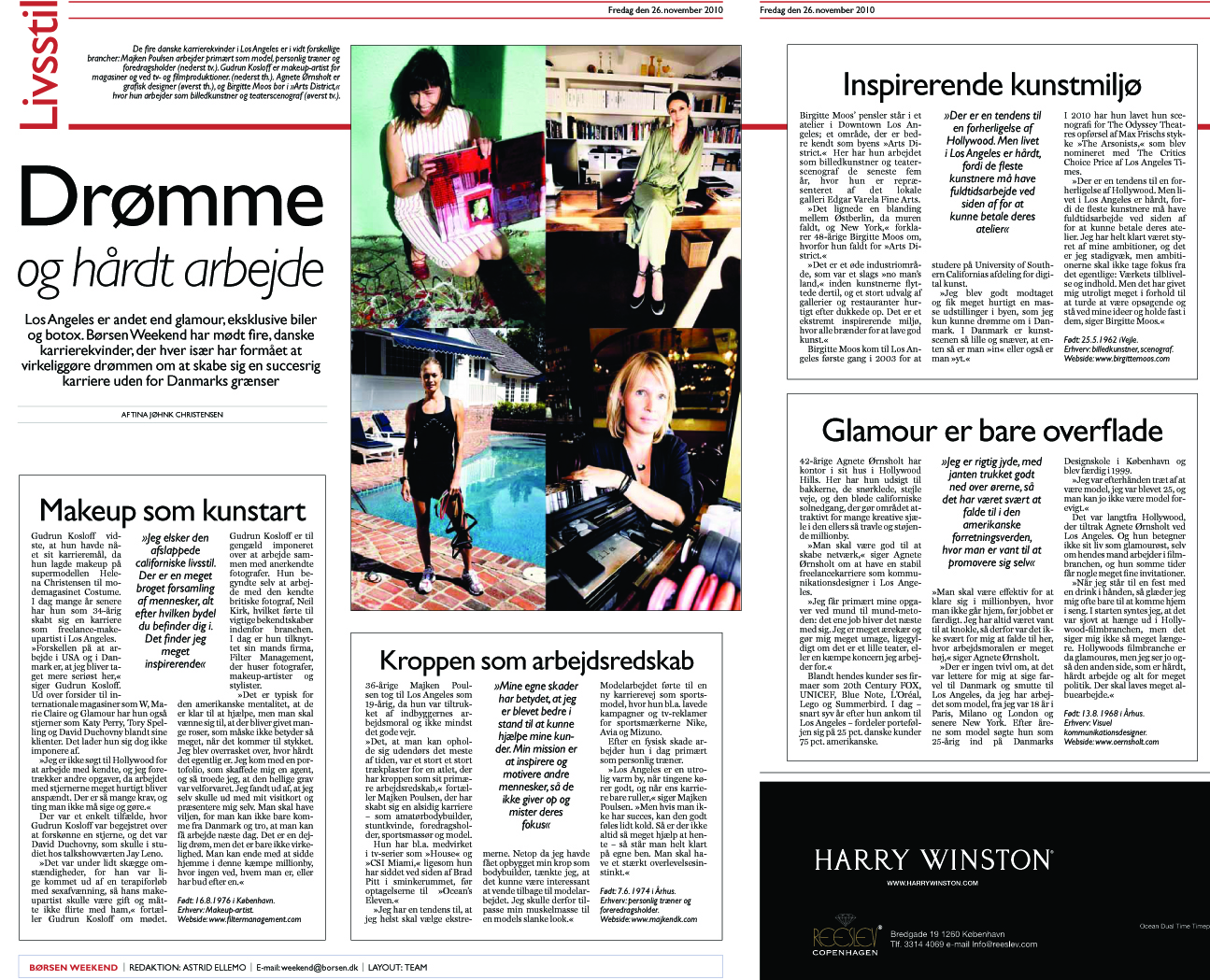
THE TALK WAS AN INTRODUCTION TO THE BOOK I'M WRITING ABOUT INTER-DISCIPLINARY SET DESIGN AND A DESCRIPTION OF WHAT THE RESEARCH WAS ABOUT AT THE WATER MILL CENTER, WHILE I WAS THE ARTIST IN RESIDENCE THERE.
Set design is an art form that actually can draw on several other artistic disciplines and integrate some of them in itself and its expression. Set design is a wildly interesting topic which really is visual communication, that can comment on cultural events and generate debates in society. Set design, when it is interesting, has moved far away from visual social realism in theater and backdrop painting, to abstract space structures. Which simultaneously can convey messages that support the other elements on stage, if there is a stage!
I chose to study set design, because the profession itself draws both from art, literature, psychology, philosophy, communication and anthropology. Each fields which I was enormously interested in, and therefore not able to decide which area to focus on.
September 30, 2010


July 20, 2010
July 05, 2010
Q""UOTES
"Birgitte is a very talented Painter"
Achim Freyer
Stage Director- and Designer
”Ms. Moos is a specialist image-maker, an artist, thinker and craftsperson who possesses an
extraordinary esthetic sensiblilty. She is already a visionary in the field, pionering exciting new
areas of the cutting edge of technology and the arts, and creating striking and deeply
interesting art works in the process. She is a creative and gifted talent who not only excels but
stands out... Her work show great sensitivity, versatility and universal appeal in many genres of
artistic media. She is an excellent conceptual and creative thinker, a fine communicator, and
highly sophisticated in her use of visual language... Individuals with her combination of skills,
knowledge and talent are extremely rare and much sought after by industry. She will
undoubtedly bring prestige to any project in which she is involved.”
”I am confident that she will continue to shine and develop as one of the pioners and creative talents in the field.”
Vibeke Sorensen
Professor and Founding Chair
University of Southern California
School of TV and Cinematic Arts, Division of Animation and Digital Arts
”Scenography and its related disciplines is an increasingly important area of study and gaining
considerable academic attention. The field encompasses the visual and spatial aspects of
performance in all its manifestations. As such, it includes architecture, the plastic and fine arts,
digital and electronical media, drama, literature and related fields. It is, in other words, a truly
cross-disciplinary field of study with important implications for the contemporary world of
performance, communication, media and the like.. Someone who can bring praxis to theoretical
interrogation should be an ideal candidate for such a field of study. Ms. Moos seems to be such
a person.”
Arnold Aronson PhD
Professor and Chair
Columbia University School of the Arts,
Theatre Arts Division
”Birgitte has a high vocational base that places her in that certain category reserved for outstanding Danish mediators in the creation of film... Her accomplishments are manifold. She is an eminent Production Designer and a very talented painter. She is unusually articulate and entertaining Birgitte functions perfectly the role of a teacher.”
”Great artistic talent is characterised by the artists ability to be innovative, and this Birgitte posesses in abundance.”
”Birgitte Moos is enormously qualified to work with the education and design of television, film, video and the performing arts.”
Susanne Vad
Film Studies Director
Zentropa Productions / Station Next
”Birgitte Moos is a Danish designer, which in future may help to anchor Denmarks position in the
field of set design for film and theatrical media. Birgitte has through her earlier works showed
great professional commitment, professionalism and pioneering new ideas.”
Ulla Hovgaard Ramlau
President, Danish Design Center
”Birgitte has studied at UDK, Berlin University of the Arts, by Professor Achim Freyer. The mere
fact being accepted as student by one of this century’s most recognized scenographers and
visual artists, indicates her talent.”
Jonas Elmer
Filmdirector
June 07, 2010
NSTALLATION: The Form Behind the Form. Time defined as Form
Artist: Birgitte MoOS
Artist: Birgitte MoOS


Denmarks National College of Design/ Danmarks Designskole - Copenhagen
The object is a container containing time & the container is a temporal model, that visualizes what time is in itself when time is designed as a physical object.
The now moving in time, independent of the moment... READ MORE
May 20, 2010
***********************************************
"The Arsonists" extended through June 26th, 2010. CHRITICS CHOICE by Los Angeles Times LINK TO VIDEO
May 18, 2010
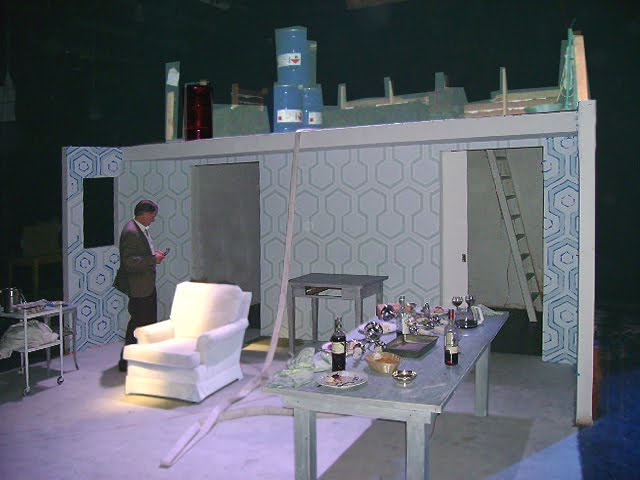
SET DESIGN for The Arsonists. American premiere at the Odyssey Theatre in Los Angeles. April 3 - May 23, 2010

Photo by Tina Jøhnk Christensen
Los Angeles Times
CRITICS PICK; Theater review: 'The Arsonists' at KOAN at the Odyssey April 15, 2010
”...Among the first-rate design elements, Birgitte Moos’ striking set holds some real surprises.”
Read more at http://latimesblogs.latimes.com/culturemonster/ 2010/04/ theater-review-the arsonists-at-koan-at-the-odyssey-theatre.html
L.A. Weekly Theater Critics. April 8, 2010
”...Set designer Birgitte Moos' beautiful two-level set (1950s-style living room and attic) is ingenious...”
Read more at http://blogs.laweekly.com/stylecouncil/stage-news/stage-raw-the-mystery-plays/#more
BEVERLY PRESS, April 8, 2010
”...super set design co-operation from Birgitte Moos...”
BACKSTAGE. CRITICS PICK: 'The Arsonists'. KOAN at The Odyssey Theatre. 7.4.2010
STAGE AND CINEMA, FIREMEN, SAVE MY WORLD, April 11, 2010
”... the look and feel of a grim East-European film of the 60s, with just the right touch of Keystone Kops madness...”
Read more at http://www.stageandcinema.com/arsonists.html
Campus Circle, May 5, 2010
”The two level set design from the wallpaper to the hanging houses was beautifully developed by Danish set designer and fine artist Birgitte Moos. (I could not expect less from a student of Achim Freyer.)...”
Read more at http://www.campuscircle.com/review.cfm?r=10879&h=-The-Arsonists-Now-May-The-Odyssey-Theatre
A CurtainUp, Los Angeles Review: The Arsonists 8 april, 2010
“Scenic designer Birgitte Moos has layered that second level attic atop a sterile white living room that looks like it might be a generic hotel room. Miniature houses representing the city float in space, and the firefighters scale metal towers to peek in the windows…”
Read more at http://www.curtainup.com/arsonistsla10.html
LA THEATRE REVIEW, April 9, 2010”The set, by Birgitte Moos... was marvelously evocative...”
Read more at http://www.latheatrereview.com/2010/04/09/the-arsonists-at-the-odyssey/
BITTER LEMONS, April 2010
http://bitter-lemons.com/2010/04/the-arsonists-100-sweet/
BITTER LEMONS, April 2010
http://bitter-lemons.com/2010/04/the-arsonists-100-sweet/




Subscribe to:
Posts (Atom)