March 30, 2008


March 09, 2008


Making the F-word fashion
We are four female painters, Sabina Mlejnek (Austria), Birgitte Moos (Denmark/USA), Vibeke Knudsen (Denmark) and Suzanne Russell (USA/Denmark), with diverse national, cultural and educational backgrounds.
We are working on a collaborative art project, and this is a project description and examples on sketches for common paintings.
Our project is an experiment in collaboration aimed at producing a series of large paintings, planned to be aproximately 13,1X6,5 ft, on the subject of notions female beauty and cultural identity. We plan to investigate our individual interpretations of the female body over time, as we collaborate to produce paintings in which the only rule is, that we may not stop each other via verbal responses to each other’s painting during the work period. Painting over each other’s work and adding to each other’s work is allowed.
The project is about the group’s working methods and dynamics. For this reason, the dynamics of the group will be documented each day through a variety of media, including video recordings and questionaires. We concider creating a website for the project, with blogs and photographs, documenting the paintings’ stages and development. The working process will be reflected in the dynamics of the paintings.
A flirtation with culturally defined ideas like ego and self, is implicit in our proposed working method and
subject matter. These ideas will be investigated and, hopefully,
illuminated by the content of the paintings themselves. Grabbing the
spotlight and worshipping beauty.
Can we let go of our egos? Can we produce paintings, that contain
references to a wide-range of styles, because we have different talents, tools and references?
Will the paintings function as symbols and aesthetically as paintings when the content is made up of a sort of cultural hacking?
Part of our project is to exhibit our collaborative paintings in each
of the countries where we are from.
We expect the essence of our collaborative paintings to be a
culmination of our observations about female beauty, especially as
it is portrayed in mass media throughout the world.
Ideals of female beauty have been articulated in Egypt, in Dante’s Italy, in art and theater, in film and television, and in advertisements. The glamour system. Especially in the West, women are given the leading role of “Figure Magnifique,” a mythical role that tries to convince the viewer, that these women are real and represent female beauty.
As a possible consequence of society’s rejection of natural look as beautiful, our paintings will comment on the scientific methods that are available to achieve beauty at any cost.
Female beauty is an indicator of success and a staus symbol. Stategies for seduction are defined in the media and the myths they create. The relationship between the sexes are affected.
Through media images we become aware of our obsessive attantion to
appearances. The perfect body. Our body becomes our identity. Our identity becomes a projection of our body as a social construction,
in which the conventional meaning of the word ”object” describes the female body, and its status in terms of time and place.
Many international female artists work with hybrid artistic expression
in which they combine, for example, photography, video, installation and
performance art. This can be interpreted as a rejection of painting
as a traditionally patriarchal medium, with the masterpiece as its result.
Painting is not related to gender in Denmark in the 21s century. In our
project , we wish to use painting as a genderless media through which we,
as female artists with different nationalities, show the world that
we use the oldest and most traditional art medium as part of
our contemporary investigation.


February 23, 2008


August 31, 2007
Phantom Galleries - Los Angeles


The Memory Palace Series. Installation and paintings
Photos by Jessica Shokrian
Photos by Jessica Shokrian
August 16, 2007

April 09, 2007


March 30, 2007


March 28, 2007

Dimensions 30X80". Acrylic and mixed media on woodpanel
Photo by Rick Mendoza
THE REASON
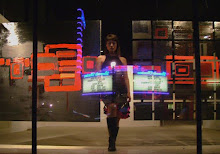
This painting is a subtract derived from an idea of a series of 5 empty storefront concept installations that I created as a commentary and anticommercial, based on the fact that the fashion week of Copenhagen in 1997, was located in a former slaughterhouse, where the particular location was called ’The Hall of the Axes’ in the Meatpacking District of Copenhagen. How ironic is that!
THE THEME:
One of the cultural differences between Copenhagen

and Los Angeles:
The self aggrandizement of women in LA.
It is not a new phenomenon, that women demand attention. Attention often gives an economic advantage. LA most of all, is a city controlled by the brutal force of financial gain, and a social and financial security network is virtually non existent, unless one is wealthy! Female beauty is a wealth magnet, as well as a status symbol. Women in LA ( all kinds of nationalities ) emulate media stars as the 'Figure Magnifique' of mythology.
THE FALLACY:
 The fashion and film industry induces the belief, that thin girls are the real representatives of beauty. A rather narrow minded ideal. The degeneration of natural beauty is far more obvious in LA, the city of celebrities and wannabes, as girls here are typically smaller in their body measurements, than their counterparts in Europe: A new Danish trend is to expose mannequin dolls in storefronts, with sizes in European sizes, has grown from a 34 to 38 and the EU parliament is currently discussing whether to provide rules for lowest BMI numbers allowed for catwalk models.
 THE MANIA:
The essence of the painting ‘White Cows’, is a culmination of an observation and research into the thematic of female beauty in modern media and fashion in Los Angeles, Copenhagen and Europe in general.
 The content of the painting consists of images inserted into a conceptually designed space; the painted area. In the digitally designed, and in the hand drawn images within the painting, the intention is to evoke/visualise flickering images, backgrounds and or particular locations! These flickering images or films, are of nanotech equipment for life extending and body-beautiful surgery, future dna manipulation, and even axes of a slaughterhouse.
 A comment on female beauty and the methods and extent used, to which people will go to in order to achieve this: Beauty conquers everything - and beauty equivocates with success.
THE THIRST:
Across the painting, there are rows of identical catwalk mannequins, posing in continuous repetitive movements, reminding of the march of a fascist parade. The mannequins stand still, a Bertolt Brechtian tableaux vivant. A black conveyor belt propels the girls, all dressed in cow skin, through the room. The floor beneath the conveyor belt is drenched in blood: The slaughterhouse!The theme of twins represents here the idea, that women also mirror themselves in each others narcississtic adoration/competition. The color scheme of the painting has conscious movement from light to dark, and from the left to the right: The concept of political progression in western society. The color palette is very feminine and deliberately misty; the location of a polluted place, where it constantly rains blood and milk...
THE RESULT:
... A parallel on the subject of being a woman in LA, and a meat market. Therefore the title, "WHITE COWS".
THE REASON:
The painting was painted as an anticommercial for a fashion week in Copenhagen, which was located in a former slaughterhouse, where the particular location was called The Hall of the Axe. How ironic is that!


February 11, 2007
'Repulsive Repetition Series



ART STATEMENT
There is a kind of cultural deep freeze in our bodies, where society paralyses our brains...
READ MORE
READ MORE


SEE ALL 16 PAINTINGS AT
http://birgittemoos.com/Repulsive%20Repetion%20Series.htmART STATEMENT
There is a kind of cultural deep freeze in our bodies, where society paralyses our brains...
READ MORE
READ MORE
Friedrich Nietzsche quote
“Art is essentially the affirmation, the blessing, and the deification of existence”
June 25, 2006

June 21, 2006

March 20, 2006

March 2006. The Arts District Citizen, Los Angeles by Birgitte Moos. Review of Parsifal, directed and designed by Robert Wilson at The Los Angeles Opera Robert Wilson is an American theatre director and scenic designer, known for being experimental in the cutting edge theatre scene, using a theatrical language where theatre becomes performance, while still being rooted in classical theatre and opera.Wilson, born in Texas in 1941, educated at the Pratt Institute in New York where he studied architecture. He is the founder of The Watermill Center at Long Island. A cross disciplinary art school, where artists comes from all over the world, to become inspired in the spirit of this leading avant-garde theatre novice.
He has staged numerous productions over the last three decades throughout the world, including works as Salome, Madame Butterfly, Parsifal, Deaf Man Glance, The Life and Times of Joseph Stalin, The CIVIL wars and Einstein on the Beach.
Wilson has been working with outstanding artists such as Philip Glass, the German director Heiner Muller, the legendary David Burne, Lou Reed, Laurie Anderson, William Burroughs,, Jessie Norman, Susan Sontag, and Tom Waits.
His theatrical interpretations consists of almost empty stages and stunningly beautiful lighting designs. Nonlinearity defined through combining different art forms into total art works, where movement, music, visual art and design are fused together into a new formula for stage work. Movements and visual effects become more descriptive rather than words being central in shaping meaning.
Wilson is directing actors into mechanistic movement patterns that usually not represent their engagement in emotional content. It seems as if the mere fact is, that the actors have to move from point to point as if counting numbers internally, while exercising the movements as practical transportation in order to create or deconstruct the story. This could be a comment on that deconstruction could be applied as an analytical method of seeing literature, architecture and so forth as that language and trends are unstable.
The works of Robert Wilson stands solely out, in this time with tendency of confusion. He masters the walk of the double-edged sword, being able to assemble the blade so that it cuts clear through centuries of scenic art forms. His imaginary visual compositions leads reason towards consciousness about philosophical, defragmented cultural expressions and connects them in soul full footprints, sliding through time and space so clearly as any intuitive and abstract intuitions about life content and communication. Communication, collaborating through music, song and body language.
Wilson’s directing is atypical in the sense of that nothing typical appears. He connects so named traditional dramatic expressions in new images, that moves slow-motoric through almost clinical yet painterly spaces, converting instructions in a written play into bodily language and executing these, one instruction at a time.
Wilson is popular in Europe. This is possibly a reaction to his nonverbal visual communication. Speakers of different languages can understand the content. Hereby not said that the audience subtracts the same content. The content is though of universal questions and ethical interactions, with outstanding ability of transferring settings and emotional content into abstract, suggestive landscapes and motions.
Wagner’s opera Parsifal, performed at the Dorothy Chandler Pavilion, is transformed into a zen-buddhistic, meditational stage version. Parsifal is a 41⁄2-hour joyous meditation on physical focus and presence. Dreamlike stunning scenic settings created through set and lighting design and geometric black and white costumes.
Wagner’s opera Parsifal, performed at the Dorothy Chandler Pavilion, is transformed into a zen-buddhistic, meditational stage version. Parsifal is a 41⁄2-hour joyous meditation on physical focus and presence. Dreamlike stunning scenic settings created through set and lighting design and geometric black and white costumes.
Wilson’s rendering of Wagner’s religious opera Parsifal is a contemporary and yet timeless sensuous illustrated work. Theatre traditions such as Japanese Noh theatre intertwined with Bertolt Brecht’s human tableau vivants: People posing silently. The figures are moving incredibly silent, now and then just about, and sometimes, jerks a posed hand mechanically back and forth as attempts made to comment on something. Or as nervous tics coming out of powerlessness against seemingly insoluble dramas, with the awareness of how hard it is to communicate verbally.
Intrinsic a slow operatic work, projecting religious systems into stylized patterns, where bodily collages slides across the stage. Illuminating occurred crisis, where seemingly minimalist movements captures gestures before they occurs, as results on uncontrolled subconscious mania. Downtempo, either as a result of emotional deep freeze, or existentialistic cultural confusion. Automatic reactions and forms repeated, hypnotically looped in complex cycles, like a mantra looking for universal harmony.
December 24, 2005


November 11, 2005
Frozen at The Ark Theatre, Los Angeles. Set design by Birgitte Moos
http://articles.latimes.com/2005/oct/28/entertainment/et-stage28
Paul Wagar directed the critically-acclaimed Ark Theatre presentation of Bryony Lavery’s Frozen, recommended by the LA Times, LA Weekly and Backstage West.
AN ICY JOURNEY INSIDE A TRAGEDY by Daryl H. Miller, LA Times. October 28, 2005
FROZEN, Back Stage West, November 10, 2005 http://www.allbusiness.com/services/amusement-recreation-services/4393108-1.html
August 30, 2005


February 21, 2005


January 05, 2005
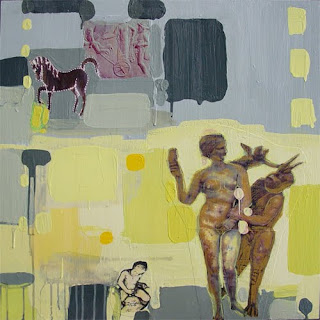
Art statement "Repulsive Repetition Series"
In my paintings, I strive to communicate from a myth-generated part of our cultural heritage revealing individual and collective patterns in the human structures of sensing the essence of being alive. My quest is to bring dreams, memories and love to life. It is then up to the voyeur to receive a subjective impression.
I returned again and again in recent years, to the theme of transformation of life.
There is a kind of cultural deep freeze in our bodies, where society paralyses our brains, and disconnects us from nature, sealing the life of feelings and making the idea of radical change almost unthinkable.
If the artist's function is to hold up a mirror to society, we may have to accept the fact that in our time, the mirrors are hazy. The wearing of a mirror, reflecting every experience back into our own consciousness is a progression from illusion to clarity.
The problem is that we are blinded by our own projections, stopping us from staying true to love and unity. So don't expect perfection.
Several of these latest paintings, particularly in Repulsive repetitions, explores thematically classical elements. Such as the Assyrians and the woman and ..satan,.. and ..satan.. and the woman, or.. carnal desires and the woman, ...are often implanted in abstractions about nature and the body feminine.
Through repetition of mythological symbols and figures, on love and passion, from earliest historical times, the paintings demand some attention. One might not be seduced at first, but then slowly, as one enters the images, a kind of pattern emerges where recognition might possibly dawn..!
I returned again and again in recent years, to the theme of transformation of life.
There is a kind of cultural deep freeze in our bodies, where society paralyses our brains, and disconnects us from nature, sealing the life of feelings and making the idea of radical change almost unthinkable.
If the artist's function is to hold up a mirror to society, we may have to accept the fact that in our time, the mirrors are hazy. The wearing of a mirror, reflecting every experience back into our own consciousness is a progression from illusion to clarity.
The problem is that we are blinded by our own projections, stopping us from staying true to love and unity. So don't expect perfection.
Several of these latest paintings, particularly in Repulsive repetitions, explores thematically classical elements. Such as the Assyrians and the woman and ..satan,.. and ..satan.. and the woman, or.. carnal desires and the woman, ...are often implanted in abstractions about nature and the body feminine.
Through repetition of mythological symbols and figures, on love and passion, from earliest historical times, the paintings demand some attention. One might not be seduced at first, but then slowly, as one enters the images, a kind of pattern emerges where recognition might possibly dawn..!
January 04, 2005
ART STATEMENT FOR "THE MEMORY PALACE SERIES"Being born into the time of no future generation pondering over how to visually manifest an idea of tracking events back to that era. Remember being impelled towards a fascinating system. A Memory Palace... An ancient technique used for almost total recall, a technique to remember vast amounts of information, before the age of universal writing ability, available to everyone. The method of loci or “ars memoriae" (art of memory in Latin)was an implement used by the scribes of the Ancient Greek World. The idea has been recurrently used in literature and film. This learning system is based on allocating physical locations in the mind, used most often in cases where long lists of material had to be remembered precisely. Familiar buildings such as churches, temples or markets, places one has physically visited are the ideal, for the task. The Library of Alexandria was often used as and referred to as a Memory Palace.
To use the method one have to go through (physically) a building repeatedly and in the same sequence whilst looking at the same places as before. Then one connect the item one have to remember witTthe places in the building, for example the parts in a complicated speech.To recall that speech you visit the places in the building with your mind, with which you have connected your speech to. The method is to ensure that you have associated ideas with pictures, localizing these pictures in a spatial place. A vast compound of space, filled with memories connected with definite places in a building. A Memory Palace. The system is fascinating. Not only just as tool for remembering, but also as a new concept, a product for the imagination, and a fount to store abstract memories: Paintings representing thoughts and memories, stored in a labyrinthine system in a house. In order to visualize the idea of this mental construct, and to provide storage space for the myriad impressions stored in the inner world of the mind and the feelings associated with it, the intention became to construct a wooden tower (the mind), where paintings (memories) are hung on the inner walls (the Memory Palace).The whole construction is to be constructed as a ramshackle house, a symbol of a scattered brain full of information. The wooden construct will have an entrance, where one can walk into the palace for a brief secretive glimpse. A perverse peep, of the creative and complex atmosphere inside the memories of someone’s mind palace. On the walls, inside the construction, is an orga-nized series of visual representations of memories: Paintings overlapping each other sometimes, as if containing uncontrollable information in underlying patterns. Every painting is a repository of memories within memories.The visual and spatial representations of the paintings, are accorded their logical and/or psychological connections. The Memory Palace Project weaves layers of psychological narrative into separate versions, represented by each individual painting, of an inner biography. The paintings store their repertoire of spells in an unpleasant temple of revelation. A brain, a storage space, in which “Dangerous” insights sets that world apart from our own reality.
Subscribe to:
Posts (Atom)