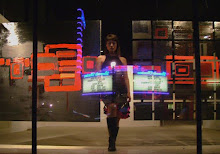
SET DESIGN FOR THE HAMLETMACHINE -
THESIS FROM DENMARKS DESIGNSCHOOL
By Birgitte Moos
I became aware in Berlin, during my studies from 1995-97. I became aware and also inspired by the ‘post-modern theater,’ its theatrical theories and works. Consequently, as a thesis project in 1998 I chose “The Hamletmachine,”[6] which in context seemed to be the obvious challenge in scenography for The Danish Design School.
“The Hamletmachine” is an early post-modern text, written before the Hans-Thies Lehmann, Post Dramatic Theater theories were published. Early in my research for “The Hamletmachine” I realized that especially the works and theories by Antonin Artaud, Bertolt Brecht, Jaques Derrida, C.G. Jung, Stanislav Grof, Gertrude Stein and the structuralist Charles S. Peirce would be relevant as interpretative tools for my own staging of the Hamletmachine.
Post-modern theater use linguistics and visual shifts and the breaking up of signs and signifiers, to allow for multiple interpretations. To apply deconstructivism in post modern theater, it is important to understand Peirce's Sign Theory which is a system with three categories; symbol, index and icon. Deconstruction, developed by Derrida, is an essential element of post-modern theater. Deconstruction is basically, to reject what we know conventionally and define as beautiful and true, and through the deconstruction of recognizable content, flipping the contents around and make stability unstable, so that a predefined meaning no longer exists. Derrida warns against just opposed meanings but also implies to juxtapose meanings or reinstate the opposite sign. By inserting the opposite sign one simply creates a new meaning.[7] Deconstructivism is about how to open up new angles of interpretation. Antonin Artaud and Bertolt Brecht were actively engaged in these kind of productions.
Applied works and theories of the above, gave my interpretation of “Hamletmachine” the possibility of freeing myself from the temptation to generate harmonious scene images. Deconstructivism allows an open interpretation, where there is no longer one single meaning. “The Hamlet machine” is characterized by the absence of a plot. The text consists of sequences of aggregated fragmentation events, bouncing in time which breaks up the stability of continuous time and textual signifiers. With references to numerous literary works and the intense use of allusions, for example to Shakespeare's Richard III, Third Reich, Hamlets place of study - Wittenberg University, revolutions and Karl Marx, the characters and events in the text are turned into fragments of world history.
This text contained the prerequisites to be looked at from the fundamental tenets of post-modern theater and deconstructivism. “The Hamletmachine” is built of complex contradictions, where the messages are entangled in a net which has no linear pattern, but with probably more threads that can be viewed from different directions.
Description of the Text
Written in 1977 by East German play wright Heiner Muller, “Hamlet machine” is a reduction to just eight pages of text, and condensed down to a list of Western civilization's evolution from the glacial epoch to contemporary time and to a dystopian future of a climate disaster. Events are relocated to a world history in relative chronological order, yet still distorted and even recreated.
The Hamlet here, is in an identity crisis that develops into psychosis. The condition mainly due to his despair and disillusionment of witnessing various ages of failed revolutions, where a growing consumer culture betrays the past and carries with it a cycle of violence. He recognizes similar historical patterns repeating themselves in different eras.
Hamlet's schism builds up since he, in Jungian terminology, does not acknowledge his own subconscious and fails to integrate intellect with emotion. He realizes that his beloved classical philosophy is not sufficient to create social change. This realization that human intelligence is limited results in doubts of both his own identity and the survival of culture, and perhaps even in the justification of his own claim. He circles down in a growing frenzy which is split between the masculine and the feminine, anima and animus, mixed with memory flashes and the breaking up of his own linearity.
Hamlet's split nature is a response to the Western Canon's representation of the intellectual faced with misfired revolutionary changes, and becomes the central theme of the text. His debacle ends with a wish for a fusion between man and machine. The text points also to the notion of the age of technological opportunities, where concepts such as post-humanism, cyborg bodies, virtual reality and robots can become a reality.
The “Hamletmachine” is a critique on society and of the self ironic opposite facing mankinds intellect in the Western world. Hamlet is presented as an identity seeker in his struggle to make sense of Doomsday-like events, but ends as a tragic figure who capitulates and denies love as well as the human species.
The scenography
In my staging I let everything take place in a site-specific 80 meter tall gas silo in Copenhagen.
Found architectural performance space and transgressing border were my focal points; fostering new ways of testing the barrier between the audience and performers in order to break down the line between ’art and reality’ inspired by ideas from Brecht, Artaud and a few other theatre practitioners and theorists.
My intent was to explore the art of theatrical scenography. From challenging gravity to creating a language through non-realistic imagery and to explore the interaction of the audience and the stage.
This staging questioned how and where the viewer experienced recognition and intuitive understanding of the content of the performance and scenography, as it relates to the environment of the action on the stage.
The play leaps in and out of different cultural eras and time zones. The main concept was to create a three dimensional collage of a degenerating culture through defragmentation and the assembling of the past into present and future.
This scenography lets everyting take place on a circular stage constructed inside the silo, inspired by the shape of an ancient amphitheatre. In a theatrical context, Greek theatre is the root of the Western world’s theatre tradition. The circle concept was developed to present a cyclical model of time as a container for the text content. The audience is seated in the center of the silo on an illuminated transparent circular floor encircled by the entire stage.
The circular stage, encircling the audience, is constructed on five different annular levels. The varied scenography spans over more layers in order to create the experience of fragments of events and the jumping in time. This enabled me to construct different stages on all the levels around the audience, giving them an heightened experience of the different time zones. Each time frame attached with different historical events.
Time is illustrated circularly from the rear and above to the front and down towards the audience. The past is the furthest away from the audience and present right in front of them. The audience sits, in a figurative sense, in the future.
Behind the first annular rear ring and out into space there is ‘nothing", a great room of darkness depicting time before ancient philosophical and Western European self-understanding. The actual first rear upper annular stage represents ancient and old values. The second annular ring forms the foundation for the Age of Enlightenment, where philosophy was again in resurgence after antiquity. The third and middle ring carries revolutionary events like the 1913 October Revolution and the division of Budapest. The fourth and lower ring provides space for literature, and personalities from the previous century up to the Baader Meinhof group's activities in Germany. The fifth and last annular ring at the bottom and closest to the audience includes the present.
The setting allows the performers to move from any point in time and space, backwards and forwards, around the audience, moving up and down from ring to ring. Thus, involving the entirety of the audience to visualize also the entirety of the performers as they move in and out of the different time frames.
The atmosphere and the dimensions inside the silo hints to the relation in Hamlet's dilemma, that personalized intelligence can be overestimated when compared to a bigger ‘something’ which we do not know as of yet and which is not a ‘comme il faux’ to surrender to as a member, of the Western European intelligentsia. With this interpretation I deconstruct a deconstructed text and relate myself utterly and politically incorrect to Heiner Muller's academic ‘agenda.’
In this context a gas containing silo also refers to the 20th century’s consumerism, and to galaxies created light-years away in the universe. Natural gas now supplies energy for numerous industrial processes in excessive consumption levels. And our galaxy, the Milky Way is a gigantic collection of stars, gas and dust as well as a significant proportion of invisible dark matter. Immediately after the Big Bang everything was totally dark. Since the primordial universe expanded, light could then begin to emerge as cosmic microwave radiation. It is this radiation which some believe creates climate change. The gas silo thus becomes a representation of something, which can be decoded in multiple directions, and not a reality.
Stanislav Grof is cited as a reference because he is one of the most important pioneers in the scientific understanding of consciousness. His concept has many features in common with CG Jung's concept of the world. While CG Jung's scientific works dealing with the self's individualisation, the collective unconscious and archetypes added Groff’s approaches a new dimension to psychology. Groff’s Transpersonal psychology, which was developed in the 1970s, dealing with existential and spiritual issues and human development opportunities through integration of body, mind, soul and society.[8] His theories on the individual's transcendence, opens up a radical angle of how Hamlet could escape his intellectual prison; through a transcending awareness of the interconnection of all things. This solution would at best in the post-dramatic manner break with ”Hamletmachine’s” intertextual references, as it pointed in a completely new direction without contrasting meanings and signs.
One of Artauds ideas was to place the audience in the middle of what he called a spectacle. Interestingly enough a spectacle indicates familiarity with the words spectacular and spectator: Viewer and striking. In my mother language, Danish, the word ”spektakel” means disturbing noise. So in Artauds interpretation, it can be assumed that a spectacle includes the spectators whose view from the middle and overwhelmed by almost deafening sounds from from all sides, become aware of themselves. Artaud wanted the audience to be completely absorbed by a performance. He compaired this construction to what it would be like to be in a vortex.
I took a sequence of Artauds idea and placed the audience in the middle of the scenario, where they had no chance to escape, and became an example of how a contemporary ’Theatre of Cruelty’ could be experienced.
The audience position, ‘in the future’ is simulant for the fact that they are seated on a ‘living organism’. The transparent circle being a simulacrum for the globe or world is a scenographic attempt to break down the psychological barriers between audience and stage and to have the audience experience the show with physical sensations. I wanted the audience to experience themselves taking part in this performance. To work with light in the audience area of various colors and intensities, shining up through the glass circle, my intent was to affect the audience emotionally and physically. The audience sat on the swivel chairs and had an unobstructed view of the whole scenography throughout the performance. This kind of multi-perspective staging supported the concept of the post-modern theater.
The surface of the whole set scenography’s foundation, the five circlelayers is covered with asphalt-coated cardboard. as a reference to Germany's siege of Europe during the Second World War, when they brought freeways through much of Europe. A part of world history that can neither be separated from political events from before the second world war, or from the traumatic after-effects of the war inflicted populations.
I developed a staging concept that implemented deconstruction as a design method. As in a semiotic system, where one can begin to unravel the components. I excised elements out of the foundation and base of scenography and replaced them in other places on the stage. As long as it paid in other contexts rather than a text based form. Deconstruction, as a scenographic concept of a post-modern text.
I consequently cut many elements out of the scenography’s layers and placed the elements elsewhere on the stage. In this way parts of scenographic content was shifted. For example in Act IV. "Pest in Buda / Battle for Greenland" where parts of the scene's foundation at the location where the scene unfolds, was cut in rectangular pieces and placed upright elsewhere on the stage. The parts then became included in a new context, which opened for a hybrid interpretation. My hope was to create an experience of a coincidence principle. A principle of perfection through "de-form 'where the known and the aesthetic material was broken up.
Philosophical Reflection on the notion of time
The content of the silo, the container, is temporal. Its content visualizes what time is, in itself, when it is designed as a physical and abstract object, the scenography. The object itself is a container containing time. The silo is incomprehensible from the inside, giving the audience an experience beyond time and space. The scenography has transformed time into an object, where the object is subject to the spectator attendance.
When a spectator enters the container and places himself in the center, the person is inside time. Inside the container many time periods are reflected. Regarding the time reflections, I took a starting point from Jaques Lacan’s theories of ’Mirror Stages’. A human is in violence of time, and perceives time as a pressure. The experience inside the container becomes thus claustrophobic and self-referential. The sequences of events that are inside in time (present, space, sound) are variant.
Act I. "Family Scrapbook. Funeral and rape of his mother"
I designed and installed two golden columns from ancient Greek architecture but made of plastic! The columns indicated that we were inside as well as outside a castle as both were to be understood as Richard lll and Hamlet's castle. At the same time the pillars pointed against the Greek tragedy ”Oedipus” because of the scenographic deconstructed element’s choice of materials, the plastic surface, the colour gold, the shape and the time-specific signaled simultaneously at least three different interpretations.
Act II. ”The Europe of Women.” Ophelia: ”I set fire to my prison”
Four identical upright rectangular panels with spaces in between depicted the framework for the marital home’s four walls. A rigorous formal composition as an image of conformity and gender roles. The gaps in between the panels dismantled the content of Ophelia's claustrophobic statement.
Act III. Scherzo. ”The university of the dead. Whispering and muttering from their gravestones - The dead philosophers Museum”
I placed glass showcases with seemingly lifeless, naked actors inside. Above and around the showcases was a minimalistic, unornamented golden portal, which implied a classical theatrical framing and reminding one of an oversized gilded guillotine; a meta-reference to the French scholars academic stand on philosophy. From the Napoleonic Wars to 1949 guillotines were in use in Germany and France. France’s last execution carried out by the guillotine was in 1977. The same year ”The Hamletmachine” was written ...
Act IV. "Pest in Buda / Battle for Greenland. (... Three TV channels without sound.) "Assigns "Hamletmachine" at the set is a monument”
The scenographic elements are constructed of two monumental cement walls with cast iron bars. An opening between the walls enabled the actors to perform at the higher lying anullar discs. An example of how time jumping was integrated into the same scene.
In Hamlet's 'descent into hell' in Act IV, I let Hamlet go down between the archaic monolithic pillars, placed in pairs on each of the foundation circles, from top to bottom and towards the future. One idea was that the audience in Act IV, where Hamlet concludes "I want to be a Machine," should have been able to control his movements with a remote contol or a joy stick.
The result would be that Hamlet was imposed involuntary movement and driven around hither and tither throughout the whole room, by a surrounding cultural system, in this case the audience's norms and subjectivity: A homeless hero’s fight against himself ended in an unresolved recognition that stories of the past repeat themselves in the present and obviously again in the future. Unfortunately, it was not technically feasible. The consequences of an attempt to integrate interactive audience in the show would have ended in senseless violence.
My idea led me to the studies of the Australian artist Stellarc’s works and thoughts. He develops what he calls ’virtual’ bodies that can interactively connected with each other. Stellarc states that their new modes of high-tech interaction could break cultural memory and the old ways of Western thinking. This scenario would have been a relevant solution to Hamlets schism, a Hamlet still functioning on memory.
I am not on a mission to neglect humanistic traditions and values, on the contrary, the thought experiment was only an attempt to find new performative forms.
Act IV. Ophelia: "I am Electra speaking. In The Heart of Darkness. Under the sun of torture. To the capitals of the world ... I take back the world you gave birth two"
Ophelia sinking into the river. The Glass Circle is lit with a cold blue light from below to generate the feeling of sitting on ice. A scarey picture of how things can go wrong. The river Ophelia sinks in is Chronos’ time and the stream of life, frozen. Ophelia drowned in the flow of events.
In the last scene of Act IV, the lighting was a strong white light projected from the jet-black space of the darkened space above the audience and onto the audience, creating the atmosphere of a universe absent of light. The rest of the silo shrouded in the dark.
The final image dealt with Muller’s multi-referential writing form and could therefore be decoded in several directions.
At the end there was just the light, the whiteness at the audience. One idea was to turn this mysterious light to poetic use, involving a cosmos so far away that it is beyond the experience of man and therefore almost impossible to grasp. The beam could pave the way towards the light at the end of the tunnel, it could be perceived as the white light people describe in a near death experience or rebirth experiences which was one of Groff’s research fields, and thus become a ray of hope and consciousness quantum leap. Another idea was to suggest the humanity moves in an information society, where all things are registered and the individual is under constant surveilance. The audience could also choose a version were they stared into a gaping black hole, darkness outside the light that engulfed everything, including the hope for humanity's ability to positively influence the future. ”The Hamletmachine’s” final scene was at the dawn of a new ice age. The ice age in ”The Hamletmachine” was the consequence of a global climate warming, caused by Western civilization.
The final image ends as statement on an evolutionary step backwards, that progress or the circle cycle is complete. Where the circles of time, with its historical events running in loops and keeps returning to the same set of events. The acknowledgement remains disturbed and perhaps unfulfilled, depending on the audience's own historical and multicultural reference layer. This interpretation of ”Hamletmachine” does not paint a clear picture of either a disaster or catharsis.


 The fashion and film industry induces the belief, that thin girls are the real representatives of beauty. A rather narrow minded ideal. The degeneration of natural beauty is far more obvious in LA, the city of celebrities and wannabes, as girls here are typically smaller in their body measurements, than their counterparts in Europe: A new Danish trend is to expose mannequin dolls in storefronts, with sizes in European sizes, has grown from a 34 to 38 and the EU parliament is currently discussing whether to provide rules for lowest BMI numbers allowed for catwalk models.
  The content of the painting consists of images inserted into a conceptually designed space; the painted area. In the digitally designed, and in the hand drawn images within the painting, the intention is to evoke/visualise flickering images, backgrounds and or particular locations! These flickering images or films, are of nanotech equipment for life extending and body-beautiful surgery, future dna manipulation, and even axes of a slaughterhouse.