February 21, 2005

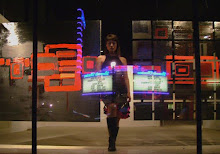
Don O'Melveny Gallery - Los Angeles.      Buddha Lounge                Photos by Tina Jøhnk Christensen  

January 05, 2005

Art statement "Repulsive Repetition Series"

In my paintings, I strive to communicate from a myth-generated part of our cultural heritage revealing individual and collective patterns in the human structures of sensing the essence of being alive. My quest is to bring dreams, memories and love to life. It is then up to the voyeur to receive a subjective impression.

I returned again and again in recent years, to the theme of transformation of life.
There is a kind of cultural deep freeze in our bodies, where society paralyses our brains, and disconnects us from nature, sealing the life of feelings and making the idea of radical change almost unthinkable.
If the artist's function is to hold up a mirror to society, we may have to accept the fact that in our time, the mirrors are hazy. The wearing of a mirror, reflecting every experience back into our own consciousness is a progression from illusion to clarity.


The problem is that we are blinded by our own projections, stopping us from staying true to love and unity. So don't expect perfection.


Several of these latest paintings, particularly in Repulsive repetitions, explores thematically classical elements. Such as the Assyrians and the woman and ..satan,.. and ..satan.. and the woman, or.. carnal desires and the woman, ...are often implanted in abstractions about nature and the body feminine.
Through repetition of mythological symbols and figures, on love and passion, from earliest historical times, the paintings demand some attention. One might not be seduced at first, but then slowly, as one enters the images, a kind of pattern emerges where recognition might possibly dawn..!

January 04, 2005

ART STATEMENT FOR "THE MEMORY PALACE SERIES"
Being born into the time of no future generation pondering 
over how to visually manifest an idea of tracking events back 
to that era. Remember being impelled towards a fascinating 
system. A Memory Palace... 
   
An ancient technique used for almost total recall, a 
technique to remember vast amounts of information, before 
the age of universal writing ability, available to everyone. 
The method of loci or “ars memoriae" (art of memory in Latin)
was an implement used by the scribes of the Ancient Greek 
World. 
The idea has been recurrently used in literature and film. 
This learning system is based on allocating physical 
locations in the mind, used most often in cases where long 
lists of material had to be remembered precisely. Familiar 
buildings such as churches, temples or markets, places one 
has physically visited are the ideal, for the task. The 
Library of Alexandria was often used as and referred to as 
a Memory Palace.       

To use the method one have to go through (physically) a 
building  repeatedly and in the same sequence whilst looking 
at the same places as before. Then one connect the item one 
have to remember witTthe places in the building, for example 
the parts in a complicated speech.To recall that speech you 
visit the places in the building with your mind, with which 
you have connected your speech to. The method is to ensure 
that you have associated ideas with pictures, localizing 
these pictures in a spatial place. A vast compound of space, 
filled with memories connected with definite places in a 
building. A Memory Palace. 
The system is fascinating. Not only just as tool for 
remembering, but also as a new concept, a product for the 
imagination, and a fount to store abstract memories: 
Paintings representing thoughts and memories, stored in a 
labyrinthine system in a house. 
In order to visualize the idea of this mental construct, and 
to provide storage space for the myriad impressions stored 
in the inner world of the mind and the feelings associated 
with it, the intention became to construct a wooden tower 
(the mind), where paintings (memories) are hung on the inner 
walls (the Memory Palace).The whole construction is to be 
constructed as a ramshackle house, a symbol of a scattered 
brain full of information. The wooden construct will have an 
entrance, where one can walk into the palace for a brief 
secretive glimpse. A perverse peep, of the creative and 
complex atmosphere inside the memories of someone’s mind 
palace. On the walls, inside the construction, is an orga-
nized series of visual representations of memories: 
Paintings overlapping each other sometimes, as if containing 
uncontrollable information in underlying patterns. Every 
painting is a repository of memories within memories.
The visual and spatial representations of the paintings, are 
accorded their logical and/or psychological connections. 
 
The Memory Palace Project weaves layers of psychological 
narrative into separate versions, represented by each 
individual painting, of an inner biography. The paintings 
store their repertoire of spells in an unpleasant temple of 
revelation. A brain, a storage space, in which “Dangerous” 
insights sets that world apart from our own reality. 

January 03, 2005

SET DESIGN FOR THE HAMLETMACHINE - 
THESIS FROM DENMARKS DESIGNSCHOOL
By Birgitte Moos  


Semiotics and icons.
I became aware in Berlin, during my studies from 1995-97. I became aware and also inspired by the ‘post-modern theater,’ its theatrical theories and works. Consequently, as a thesis project in 1998 I chose “The Hamletmachine,”[6] which in context seemed to be the obvious challenge in scenography for The Danish Design School.

“The Hamletmachine” is an early post-modern text, written before the Hans-Thies Lehmann, Post Dramatic Theater theories were published. Early in my research for “The Hamletmachine” I realized that especially the works and theories by Antonin Artaud, Bertolt Brecht, Jaques Derrida, C.G. Jung, Stanislav Grof, Gertrude Stein and the structuralist Charles S.  Peirce would be relevant as interpretative tools for my own staging of the Hamletmachine.
Post-modern theater use linguistics and visual shifts and the breaking up of signs and signifiers, to allow for multiple interpretations. To apply deconstructivism in post modern theater, it is important to understand Peirce's Sign Theory which is a system with three categories; symbol, index and icon. Deconstruction, developed by Derrida, is an essential element of post-modern theater. Deconstruction is basically, to reject what we know conventionally and define as beautiful and true, and through the deconstruction of recognizable content, flipping the contents around and make stability unstable, so that a predefined meaning no longer exists. Derrida warns against just opposed meanings but also implies to juxtapose meanings or reinstate the opposite sign. By inserting the opposite sign one simply creates a new meaning.[7] Deconstructivism is about how to open up new angles of interpretation. Antonin Artaud and Bertolt Brecht were actively engaged in these kind of productions.
Applied works and theories of the above, gave my interpretation of “Hamletmachine” the possibility of freeing myself from the temptation to generate harmonious scene images. Deconstructivism allows an open interpretation, where there is no longer one single meaning. “The Hamlet machine” is characterized by the absence of a plot. The text consists of sequences of aggregated fragmentation events, bouncing in time which breaks up the stability of continuous time and textual signifiers. With references to numerous literary works and the intense use of allusions, for example to Shakespeare's Richard III, Third Reich, Hamlets place of study - Wittenberg University, revolutions and Karl Marx, the characters and events in the text are turned into fragments of world history.

This text contained the prerequisites to be looked at from the fundamental tenets of post-modern theater and deconstructivism. “The Hamletmachine” is built of complex contradictions, where the messages are entangled in a net which has no linear pattern, but with probably more threads that can be viewed from different directions.

Description of the Text
Written in 1977 by East German play wright Heiner Muller, “Hamlet machine” is a reduction to just eight pages of text, and condensed down to a list of Western civilization's evolution from the glacial epoch to contemporary time and to a dystopian future of a climate disaster. Events are relocated to a world history in relative chronological order, yet still distorted and even recreated.

The Hamlet here, is in an identity crisis that develops into psychosis. The condition mainly due to his despair and disillusionment of witnessing various ages of failed revolutions, where a growing consumer culture betrays the past and carries with it a cycle of violence. He recognizes similar historical patterns repeating themselves in different eras.

Hamlet's schism builds up since he, in Jungian terminology, does not acknowledge his own subconscious and fails to integrate intellect with emotion. He realizes that his beloved classical philosophy is not sufficient to create social change. This realization that human intelligence is limited results in doubts of both his own identity and the survival of culture, and perhaps even in the justification of his own claim. He circles down in a growing frenzy which is split between the masculine and the feminine, anima and animus, mixed with memory flashes and the breaking up of his own linearity.

Hamlet's split nature is a response to the Western Canon's representation of the intellectual faced with misfired revolutionary changes, and becomes the central theme of the text. His debacle ends with a wish for a fusion between man and machine. The text points also to the notion of the age of technological opportunities, where concepts such as post-humanism, cyborg bodies, virtual reality and robots can become a reality.

The “Hamletmachine” is a critique on society and of the self ironic opposite facing mankinds intellect in the Western world. Hamlet is presented as an identity seeker in his struggle to make sense of Doomsday-like events, but ends as a tragic figure who capitulates and denies love as well as the human species.


The scenography
In my staging I let everything take place in a site-specific 80 meter tall gas silo in Copenhagen.
Found architectural performance space and transgressing border were my focal points; fostering new ways of testing the barrier between the audience and performers in order to break down the line between ’art and reality’ inspired by ideas from Brecht, Artaud and a few other theatre practitioners and theorists.
My intent was to explore the art of theatrical scenography. From challenging gravity to creating a language through non-realistic imagery and to explore the interaction of the audience and the stage.

This staging questioned how and where the viewer experienced recognition and intuitive understanding of the content of the performance and scenography, as it relates to the environment of the action on the stage.

The play leaps in and out of different cultural eras and time zones. The main concept was to create a three dimensional collage of a degenerating culture through defragmentation and the assembling of the past into present and future.

This scenography lets everyting take place on a circular stage constructed inside the silo, inspired by the shape of an ancient amphitheatre. In a theatrical context, Greek theatre is the root of the Western world’s theatre tradition. The circle concept was developed to present a cyclical model of time as a container for the text content. The audience is seated in the center of the silo on an illuminated transparent circular floor encircled by the entire stage.

The circular stage, encircling the audience, is constructed on five different annular levels. The varied scenography spans over more layers in order to create the experience of fragments of events and the jumping in time. This enabled me to construct different stages on all the levels around the audience, giving them an heightened experience of the different time zones. Each time frame attached with different historical events.

Time is illustrated circularly from the rear and above to the front and  down towards the audience. The past is the furthest away from the audience and present right in front of them. The audience sits, in a figurative sense, in the future.

Behind the first annular rear ring and out into space there is ‘nothing", a great room of darkness depicting time before ancient philosophical and Western European self-understanding. The actual first rear upper annular stage represents ancient and old values. The second annular ring forms the foundation for the Age of Enlightenment, where philosophy was again in resurgence after antiquity. The third and middle ring carries revolutionary events like the 1913 October Revolution and the division of Budapest. The fourth and lower ring provides space for literature, and personalities from the previous century up to the Baader Meinhof group's activities in Germany. The fifth and last annular ring at the bottom and closest to the audience includes the present.

The setting allows the performers to move from any point in time and space, backwards and forwards, around the audience, moving up and down from ring to ring. Thus, involving the entirety of the audience to visualize also the entirety of the performers as they move in and out of the different time frames.

The atmosphere and the dimensions inside the silo hints to the relation in Hamlet's dilemma, that personalized intelligence can be overestimated when compared to a bigger ‘something’ which we do not know as of yet and which is not a ‘comme il faux’ to surrender to as a member, of the Western European intelligentsia.  With this interpretation I deconstruct a deconstructed text and relate myself utterly and politically incorrect to Heiner Muller's academic ‘agenda.’

In this context a gas containing silo also refers to the 20th century’s consumerism, and to galaxies created light-years away in the universe. Natural gas now supplies energy for numerous industrial processes in excessive consumption levels. And our galaxy, the Milky Way is a gigantic collection of stars, gas and dust as well as a significant proportion of invisible dark matter. Immediately after the Big Bang everything was totally dark. Since the primordial universe expanded, light could then begin to emerge as cosmic microwave radiation. It is this radiation which some believe creates climate change. The gas silo thus becomes a representation of something, which can be decoded in multiple directions, and not a reality.

Stanislav Grof is cited as a reference because he is one of the most important pioneers in the scientific understanding of consciousness. His concept has many features in common with CG Jung's concept of the world. While CG Jung's scientific works dealing with the self's individualisation, the collective unconscious and archetypes added Groff’s approaches a new dimension to psychology. Groff’s Transpersonal psychology, which was developed in the 1970s, dealing with existential and spiritual issues and human development opportunities through integration of body, mind, soul and society.[8] His theories on the individual's transcendence, opens up a radical angle of how Hamlet could escape his intellectual prison; through a transcending awareness of the interconnection of all things. This solution would at best in the post-dramatic manner break with ”Hamletmachine’s” intertextual references, as it pointed in a completely new direction without contrasting meanings and signs.

One of Artauds ideas was to place the audience in the middle of what he called a spectacle. Interestingly enough a spectacle indicates familiarity with the words spectacular and spectator: Viewer and striking. In my mother language, Danish, the word ”spektakel” means disturbing noise. So in Artauds interpretation, it can be assumed that a spectacle includes the spectators whose view from the middle and overwhelmed by almost deafening sounds from from all sides, become aware of themselves. Artaud wanted the audience to be completely absorbed by a performance. He compaired this construction to what it would be like to be in a vortex.

I took a sequence of Artauds idea and placed the audience in the middle of the scenario, where they had no chance to escape, and became an example of how a contemporary ’Theatre of Cruelty’ could be experienced.

The audience position, ‘in the future’ is simulant for the fact that they are seated on a ‘living organism’. The transparent circle being a simulacrum for the globe or world is a scenographic attempt to break down the psychological barriers between audience and stage and to have the audience experience the show with physical sensations.  I wanted the audience to experience themselves taking part in this performance. To work with light in the audience area of various colors and intensities, shining up through the glass circle, my intent was to affect the audience emotionally and physically. The audience sat on the swivel chairs and had an unobstructed view of the whole scenography throughout the performance. This kind of multi-perspective staging supported the concept of the post-modern theater.

The surface of the whole set scenography’s foundation, the five circlelayers is covered with asphalt-coated cardboard. as a reference to Germany's siege of Europe during the Second World War, when they brought freeways through much of Europe. A part of world history that can neither be separated from political events from before the second world war, or from the traumatic after-effects of the war inflicted populations.

I developed a staging concept that implemented deconstruction as a design method. As in a semiotic system, where one can begin to unravel the components. I excised elements out of the foundation and base of scenography and replaced them in other places on the stage. As long as it paid in other contexts rather than a text based form. Deconstruction, as a scenographic concept of a post-modern text.

I consequently cut many elements out of the scenography’s layers and placed the elements elsewhere on the stage. In this way parts of scenographic content was shifted. For example in Act IV. "Pest in Buda / Battle for Greenland" where parts of the scene's foundation at the location where the scene unfolds, was cut in rectangular pieces and placed upright elsewhere on the stage. The parts then became included in a new context, which opened for a hybrid interpretation. My hope was to create an experience of a coincidence principle. A principle of perfection through "de-form 'where the known and the aesthetic material was broken up.


Philosophical Reflection on the notion of time
The content of the silo, the container, is temporal. Its content visualizes what time is, in itself, when it is designed as a physical and abstract object, the scenography. The object itself is a container containing time. The silo is incomprehensible from the inside, giving the audience an experience beyond time and space. The scenography has transformed time into an object, where the object is subject to the spectator attendance.

When a spectator enters the container and places himself in the center, the person is inside time. Inside the container many time periods are reflected. Regarding the time reflections, I took a starting point from Jaques Lacan’s theories of ’Mirror Stages’. A human is in violence of time, and perceives time as a pressure. The experience inside the container becomes thus claustrophobic and self-referential. The sequences of events that are inside in time (present, space, sound) are variant.


Act I. "Family Scrapbook. Funeral and rape of his mother"
I designed and installed two golden columns from ancient Greek architecture but made of plastic! The columns indicated that we were inside as well as outside a castle as both were to be understood as Richard lll and Hamlet's castle. At the same time the pillars pointed against the Greek tragedy ”Oedipus” because of the scenographic deconstructed element’s choice of materials, the plastic surface, the colour gold, the shape and the time-specific signaled simultaneously at least three different interpretations.

Act II. ”The Europe of Women.” Ophelia: ”I set fire to my prison”      
Four identical upright rectangular panels with spaces in between depicted the framework for the marital home’s four walls. A rigorous formal composition as an image of conformity and gender roles. The gaps in between the panels dismantled the content of Ophelia's claustrophobic statement.

Act III. Scherzo. ”The university of the dead. Whispering and muttering from their gravestones - The dead philosophers Museum”
I placed glass showcases with seemingly lifeless, naked actors inside. Above and around the showcases was a minimalistic, unornamented golden portal, which implied a classical theatrical framing and reminding one of an oversized gilded guillotine; a meta-reference to the French scholars academic stand on philosophy. From the Napoleonic Wars to 1949 guillotines were in use in Germany and France. France’s last execution carried out by the guillotine was in 1977. The same year ”The Hamletmachine” was written ...

Act IV. "Pest in Buda / Battle for Greenland. (... Three TV channels without sound.) "Assigns "Hamletmachine" at the set is a monument”
The scenographic elements are constructed of two monumental cement walls with cast iron bars. An opening between the walls enabled the actors to perform at the higher lying anullar discs. An example of how time jumping was integrated into the same scene.
In Hamlet's 'descent into hell' in Act IV, I let Hamlet go down between the archaic monolithic pillars, placed in pairs on each of the foundation circles, from top to bottom and towards the future. One idea was that the audience in Act IV, where Hamlet concludes "I want to be a Machine," should have been able to control his movements with a remote contol or a joy stick.

The result would be that Hamlet was imposed involuntary movement and driven around hither and tither throughout the whole room, by a surrounding cultural system, in this case the audience's norms and subjectivity: A homeless hero’s fight against himself ended in an unresolved recognition that stories of the past repeat themselves in the present and obviously again in the future. Unfortunately, it was not technically feasible. The consequences of an attempt to integrate interactive audience in the show would have ended in senseless violence.

My idea led me to the studies of the Australian artist Stellarc’s works and thoughts. He develops what he calls ’virtual’ bodies that can interactively connected with each other. Stellarc states that their new modes of high-tech interaction could break cultural memory and the old ways of Western thinking. This scenario would have been a relevant solution to Hamlets schism, a Hamlet still functioning on memory.

I am not on a mission to neglect humanistic traditions and values, on the contrary, the thought experiment was only an attempt to find new performative forms.

Act IV. Ophelia: "I am Electra speaking. In The Heart of Darkness. Under the sun of torture. To the capitals of the world ... I take back the world you gave birth two"
Ophelia sinking into the river. The Glass Circle is lit with a cold blue light from below to generate the feeling of sitting on ice. A scarey picture of how things can go wrong. The river Ophelia sinks in is Chronos’ time and the stream of life, frozen. Ophelia drowned in the flow of events.

In the last scene of Act IV, the lighting was a strong white light projected from the jet-black space of the darkened space above the audience and onto the audience, creating the atmosphere of a universe absent of light. The rest of the silo shrouded in the dark.

The final image dealt with Muller’s multi-referential writing form and could therefore be decoded in several directions.

At the end there was just the light, the whiteness at the audience. One idea was to turn this mysterious light to poetic use, involving a cosmos so far away that it is beyond the experience of man and therefore almost impossible to grasp. The beam could pave the way towards the light at the end of the tunnel, it could be perceived as the white light people describe in a near death experience or rebirth experiences which was one of Groff’s research fields, and thus become a ray of hope and consciousness quantum leap. Another idea was to suggest the humanity moves in an information society, where all things are registered and the individual is under constant surveilance. The audience could also choose a version were they stared into a gaping black hole, darkness outside the light that engulfed everything, including the hope for humanity's ability to positively influence the future. ”The Hamletmachine’s” final scene was at the dawn of a new ice age. The ice age in ”The Hamletmachine” was the consequence of a global climate warming, caused by Western civilization.

The final image ends as statement on an evolutionary step backwards, that progress or the circle cycle is complete. Where the circles of time, with its historical events running in loops and keeps returning to the same set of events. The acknowledgement remains disturbed and perhaps unfulfilled, depending on the audience's own historical and multicultural reference layer. This interpretation of ”Hamletmachine” does not paint a clear picture of either a disaster or catharsis.

January 02, 2005

FAKE IT TILL YOU MAKE IT 
"...Fake it Till You Make It is a visual commentary on contemporary visual art practice and spectator attendance. Produced by using threads to art history and current ‘art trends’. It is a site-specific and politically anarchistic work created for the Autumn Lights exhibition at Pershing Square in Downtown, Los Angeles, September 2009..."  


...continued from main page...
... Specifically intended to be positioned above the escalator to the parking lot under Pershing Square. The site-specific placement of the work is a commentary on the spirit of the place. But the work could as well be placed in Berlin, as Berlin like Los Angeles is a multicultural metropol and melting pot frequented by people of all ages and social ties. Berlin is also a sister city of Los Angeles!

The dominating blue metal color in Fake it Till You Make It is a metaphor for the 20th century. As Autumn Lights in Latin means melancholy, I interpret this as death, followed by emptiness, leading to new beginnings. The blue geometric traces indicates here a melancholic trip from sources for civilization; the production of infrastructure in ancient Greek city states to cities encapsulated by Freeways, precisely as Downtown LA and Berlin, to technological virtual highway Internet traffic.


The work also examines the impossible question of whether all art is already done or if it is still possible to generate new innovative ideas. Can an artist's understanding of art history serve to generate new groundbreaking work.
Fake it Till You Make It plays with the notion that in present consumer-related part of art communication, it often seems to be about that the artist executes a new idea. The title Fake it Till You Make It may for example refer to that phenomenon one as an artist finds when similar ideas occurs simultaneously elsewhere in the world. And the results can seem as if some of the artists apparently, deliberate or not, are copying other artists' works and ideas. Perhaps ideas are ‘just’ echoing each other. Reversely, the title also indicates that exercises in copying masterpieces, generates a mastery of techniques, that can lead to mastery of new and precisely executed artworks.

Fake it Till You Make It has a three-dimensional character. The different visual fields are located in different levels on the foundation. The foundation is the 4 largest rectangular surfaces. The surfaces have some cut out ‘windows’ with inserted images, with prints on varied transparent materials. Pictures and windows provide glimpses of some of the historic trail, which provides a foundation for the work, while the sculptural objects on top of foundations refers forward in time.
To illustrate the influence of previous works, or indicating this could be a comment on CON-ART, or con-art in itself, new paintings have been added on top of the foundation. These heavily influenced by original works by artists, such as Rothko. In addition there are ‘imitations’ of new works dealing with reflections like in Rorschach Tests. Obvious choice of motifs that plays on mirroring effects in relation to the ideas of echoes and reflections in Fake it Till You Make It. Recent works have also been seen, where they contain textile design or paper clips integrated on canvases. Therefore a field has in this case been added, where the surface consists of braided strips.

The text is inverted and written from right to left. This as a result of that my thoughts are projected onto the canvas. The canvas, which later placed opposite a spectator, sends its manifested message back to this new receiver who receives a reflection of a mirror. In other words; a double projection. Throughout this new meeting, the word order again turns into both a visually and linguistically recognizable structure.
If the artist's function is to hold up a mirror to society, we may have to accept the fact that in our time, the mirrors are hazy. The problem is that we are blinded by our own projections. An image of that we in the West reflect each other, unlike for example in Buddhist philosophy, where it is about stopping projections in order to see clearly.

Thus the work is quite complex, multi-referring and immediately incomprehensible. Just like life.
by BIRGITTE MOOS 


PRESS RELEASE
Curated and organized by local Artist Lilli Muller
In partnership with the City of Los Angeles Parks and Recreation and Art2, AUTUMN LIGHTS LA 2009 debuts at Pershing Square Park as an annual event in Downtown Los Angeles.

In the sprit of Los Angeles’ Sister City Berlin and its annual "Festival of Lights," AUTUMN LIGHTS LA 2009 showcases LA artists, presenting various forms of studio and performance art that feature installations, performances and projections utilizing the medium of light. Beginning in the afternoon, visitors are introduced to exhibits from cutting edge Los Angeles artists and performances by musicians and entertainers.  Into the night, Pershing Square will be literally transformed as the entertainment continues and a range of illuminations and projections light up park sculptures and surrounding buildings.

This day-to-night arts festival will include concessions and community information booths and is open to the public, free of charge and is curated and organized by local Artist Lilli Muller.

January 01, 2005

INSTALLATION: The Form Behind the Form. Time defined as Form
Continued
... Both the time flowing through time and time represented through externally gauze lashed embalming of the object's form. The time process is temporarily halted for a period, in which the embalming technique gives associations to a particular historical period of time, while the object's shape in itself does not refer to the same time
It provides the object with displaced time meanings contained in itself.

The container hangs suspended in space at a height that allows the viewer to look into the time period inside the container. When the viewer enters the container is the person inside time. Inside, the container is covered with mirrors, which mirror many times. Human is in the violence of time, and perceive time as a pressure, so the experience inside the container becomes claustrophobic and self-referential.

The now moving in time, independent of the moment. A tape loops forever with the artist's voice reciting nownownownownownownownow. There is only one now within time.

The container is open at bottom and top. Its time has stagnated in its free-floating placement. A perpetual state of itself, while the sequences of events that are inside in time (present, space, sound) are variable and flowing through like the river Kronos.

The container is incomprehensible, like the concept of time, but the materials and form language of it are set together so they give the audience a wholeness experience beyond time and space. The exhibition space is transformed into a scene, where the container is subject to the spectator attendance, and the almost architectural container invites audience into its room, as a performance which takes place in a physical place.

December 31, 2004

Transcendental images and spiritual symbols in the millennium epoch of Hollywood films - 
studies of religious signs and symbols in films By Birgitte Moos, 2002    
    
                                                                  'An inner constitution becomes a concrete outer'
                                                                                                                          Shakespeare        
 
During the change of époque and within the new century, significant changes appear in the visual media
regarding filmmaking. Computer modeling techniques makes it possible to generate images of until recently unseen character. It is a newer tool in the toolbox of a Production Designer.          
Film is such a new art form, that at that time where movies appeared in, it automatically moved itself into
an atheistic epoch; characterized by the belief in nature science and instruments. In newer films created in
the years around the millennium, I see a tendency of expressing more spiritual content than ever before in
that part of film history, which is tied to Hollywood.Perhaps that is because the transition to year 2000 has in several hundred of years stood out as an ultimate critical moment for manhood. That moment is built up through time with prophecies of Judgment Day simultaneously with visions of a better world.As a popular medium, the film is a credible measurement of consciousness within populations. One can also assume that film can have the effect on people as being catalysator of change of consciousness.          
I am methodically researching on a number of films, with the focus on used religious and spiritual signs and symbols in these films.
The selected films are all created from during 2000 until now. The selection and limitation of films are also decided out of criteria of high visual aesthetic, digital treatment and being produced in Hollywood.          

Problem description
We are living in the dream society, where information technology and digital media feeds dreams and leaves space for self-forgetting and self-absorption. The entrance to film on the net is almost unlimited for every single up coupled human. Always on the highway to paradise.Here it seems that religion and remarkably spirituality gets increased interests amongst present humans, and that seems to be reflected in filmmaking.
The two conceptions have different meaning. Generally I would nail that religiousness is about conducting oneself with the holy and powers: spirits, demons, gods, laws, and ideals. Identification with a set of man given parameters. In spiritually its considered that existence is of a character of a completeness that transcends beyond human itself.  
Religion and spirituality has different signs and symbols. The symbol is for example an image of something familiar, but also the carrier of something vague, and universal truths. The spirit shown through the symbol, for example Jesus Christ, is the image, which makes the human grasp what lies beyond its ability for the understandable. During an investigation of the meaning of a symbol, transcendent imaginations appear and the common sense must capitulate. The cognitive value of symbols lies beneath the rational sense of perception. The German word for symbol is ´sinnbild´, which means emblem. Has the picture the potency of revelation”?

I will try to categorize symbols out from different theoretical entrance angles. There are several definitions of what a symbol is and attempts of categorizations amongst others by Hegel, Goethe and Jolande Jacoby.The Swiss Psychologist Carl Gustav Jung’s works about archetypes have created a fundament of interpretation of symbols in the West, while works of the contemporary American Philosopher Ken Wilbur does in my interpretation feed the ideas of that, there exist Jungian archetypes, but also transpersonal archetypes. The archetypes must in this context be used in the connection to symbols. Ken Wilbur is by C. G. Jung’s former assistant described as the Thomas Aquinas of our days. Thomas Aquinas has in `! Sent prolog 9.1.a.v`. 4, said that Theology ought to be expressed in a manner that is metaphorical, symbolic and parabolic”. What a beautiful picture.Ken Wilber works at developing a new kind of science; a spiritual science, where science and religion becomes integrated.

I will try to pursue these new thoughts and try to involve them in future research. Carl Gustav Jung is known for his re-interpretation of religion as symbolic, and his symbol interpretations include the world’s main religions and some esoteric traditions. In Jung’s symbol language is it not necessarily the symbol in itself, but also symbolic productions, which are expressions of religious and spiritual consciousness.          
Myth critique gives a third point of view to the studies of religious symbols. Myth critique defines religion broadly unlike than what for example theologians do. Myth critique opens up for a broader study of religious symbols, since a mythological approach reads symbols as transcending, cultural and individual traditions into universal symbols!
The analysis goes into and behind some of the Westerns cultures scientific world understandings and science results. Cosmology is the teaching about the universe and implicit that, has always been a wondering about the mankind’s placement in the universe. Especially the Western cultures´ materialistic and mental development, have possibly reached a point of state where the spirit expands into a spiritual/religious cosmology. Detached from the scientific doctrines about the universe, exists an own mythic cosmology, which involves myths, gods, souls, intelligences and a metaphysical God.

Method
These investigations are part of a Ph.D. proposal that I gave in to The National Danish College in Copenhagen in the year 2002. The Ph.D. was declined based on the assumption that the content lacked sufficient scientifically. The academic paradox is self evident with reference to the subject matter: How to define and prove the numinous.I am still curious about above described subjects and will involve following methodic researches in a far deeper analysis of 'The Matrix' trilogy and other films. The field of problems lies within pinning down, defining and classifying the symbolic image language of the
chosen films. What is interesting is also how the designer through methodic work, transforms soul full content into a filmic work. In other words the ability to vitalize a symbol into a scene through the use of images.
The plan is to analyze every single film, finding the religious/spiritual symbols. Then separate digital designed symbols from ´traditionally graphic and manually on set designed symbols. Categorizing
common trades and differences.My intention is to research and analyze on the topic if cg images gives a greater opportunity for visualization of symbols, where the impression gives the wiever a stronger sensation of the old alchemistic principle “spirit in the matter”. In other words, Figuring out, if  cg design, gives ability of creating symbols with intensified transcendental qualities.
In my consideration of how signs and symbols appears, I will try to point out and define religious and spiritual signs and symbols, and the term symbol has to be examined and clearly as possibly defined. For example by describing when is a symbol is a religious symbol. Where the symbol comes from, and what it means in a given film and in its original context.

The term deconstruction, defined in 1968, by Jaques Derrida, can perhaps be found as a parameter of measuring modern fusion symbols, where different religions and belief systems are mixed together, or up, if one dare to say so. Describing different types of symbols, such as in which forms they are represented: Either graphicly designed or concrete beliefs objects such as statues, altarpieces, ikons, crosses, animals, plants or when are the symbols hidden and subtle.
A discussion of the fundamental concept; the concrete, is essential in this context, in an attempt of organising a system.
In investigation parameters and methods, an attempt of narrowing the contempt arise through the use of shape definitions such as style, color, light, materiality and immateriality.It would be interesting to typologylize films in such genres as pluralism, mythological, Theological, violent, non violent (the good versus evil). Designtools applied; digitalization, hand drawn, built in reality, mixed media. Religious, phenomenaligycal, psycological and philosophic angles of wievpoints should be considered.
The research methods should implicit reflect, that we are dealing with complex issues in a multifaceted time. Speculations of how modern media – film and computer – can bring about symbolic images, is also a question which is illuminated by questioning the wievers experience of intensity in comparison to the image layers deeper content and in comparison to applied technologies.
I am analyzing different computer software used for image manipulation creating religious and spiritual symbols. My investigations will end up with new categorizations of religious sign and symbolic expressions within different filmic genres. I expect the new insights and content will be published in a compendium, which is addressed to design and film students, workers in the fields
and other interested readers. The compendium would hopefully be a valuable learning tool about design processes and the use of symbolic language, helping readers to work goal oriented and consciously with image communication in films.
My intent is to be part taking in what lies within the development of the field of Production Design, by uncovering different use of symbol visualization.On good and bad the film as popular medium is both a measurement and creator of values and belief directions amongst the audience. Homogenic visual expressions, applied in complex contexts and abstract perception coupled to symbolic shapes, should at its best have mutual interaction. These are circumstances which results shows the level of conscious activity during the process of creation, reflected by the emotional level of involvement and resonance by an audience watching the film.        

Systematically the working method will consist of following in same order: 
Eksamination of chosen films          
Scanning symbols in the films and reading literature          
Classification of films signs and symbols          
Development analysis parameters          
Grading films and symbols in categories

Temporary film list of interest          
The Fountain. 2006. Directed by Darren Aronofsky, production design by James Chinlund.          
The Matrix trilogy. 1999 - 2003. Directed by Andy Wachowski og Larry Wachowski, production design by Omen Paterson.          
Solaris. 2002. Directed by Steven Soderbergh, production design by Phil Messina.          
Signs. 2002. Directed by M. Night Shyamalan, produktions design by Larry Fulton.          
Minority Report. 2002. Directed by Steven Spielberg, production design by Alex McDowell.          
Starwars: Episode II - Attack of the Clones. 2002. Directed by George Lucas, production design by Doug Chiang.          
Moulin Rouge. 2000. Directed by Baz Luhrman, production design by Catherine Martin.          
The Cell. 2000. Directed by Tarsem Singh, production design by Tom Foden.

Amongst selected films, 'The Matrix' is an example of films with content of religious, transcendent and spiritual symbols. Just to mention one scene from the first 'Matrix' film: The main character Neo is consecrated through symbolic divinity. As he is poured over by gold, I mean there are references to the goldenly imaginations of the ancient Antique. This film is a technological masterpiece, studded with visual effects, aesthetic and the use of cg. The visual effects percolate razor-sharp the abstract symbolic levels.
The film 'The Cell' includes a series of tableaux that depict captivating surrealist landscapes and spectacular imagery depicting the fantasy worlds. A truth seeking white angel, a boat in the sand and a serial killer in a cellar with many rooms. The room of the self is golden. An 8th victim in a glass water tank, that slowly fills with water. The number 8 has different religious meanings, for example
corresponding to baptism, the water and new birth. 'Moulin Rouge' is a film, telling the merciless separation between spirituality and desire, the cabaret is transformed to a golden hinduistic, sacred space. 'Star wars: episode II Attack of the Clones 2002' contains symbolism in abundance. For example dark dry landscapes with Anakins anger facing a setting sun. The disappearing sun leaving behind spiritual darkness. 'Minority Report' is a SFX visually stunning film, with integrated elaborate examples of computer effects that are rich in spiritual content.


My own background and qualifications
My professional and personal interests have to a considerable extent circled about symbols and accomplishment of knowledge about complicated designing processes, meanings and expressions. During studies at Roskilde University, I worked at a project about creative processes of creation, with the focus on religious symbols. My thesis from The National Design School of Denmark was on The 'Hamletmachine', written by Heiner Muller in 1979. The text lets Hamlet become interlaced with European culture and thrown from the past out through the future through time epochs and intertextual references, gaining awareness on the journey.
Furthermore during my studies at The University of Arts in Berlin, by Professor Achim Freyer, I worked on the play 'Oedipus', transforming the textual content to images of ramshackle abstract ruins and heavenly openings. In Berlin I also worked, as a part of my investigation of Oedipus, as a Set Designer Assistant for my professor, at Deutshes Theatre. On the side, designing alternative
set design concepts with the focus on the spiral symbol as a mental image of primeval processes and development. Also working with Bertolt Brechts play 'The Holy Johanna of the Slaughterhouse', where my set design turned out as a huge horizontal cross, which had the function of bridges between different horizontal movable spaces. The shape of the cross also appears in the performance 'Agnes of God'. In this variant vertically placed.
In my earlier work, 2000-2001, as a Lead Designer for the media concern Tristone, I developed designs for virtual worlds for computer games and interactive entertainment for television, and created universes strongly inspired by Greek mythology, Chinese religions and Greenlandic rituals.
In 2003, as an Artist in Residence at University of Southern California, Department of Film and TV at the Division of Animation and Digital Arts. The stay let me execute own design projects, participate in Lectures and screenings of relevant films and workshops connected to courses in computer software such as Alias/Wavefront Maya, Adobe Photoshop, Premiere and After Effects as well as MacroMedia, Director and Dreamweaver. Including interaktive animation, stereoscopic animation and virtual reality. That postgraduate research was a natural follow up on my intent of writing a Ph.D. and interest in new digital media and their usability regarding design for film.

Literature list          
Barry Taylor: Entertainment Theology: New-Edge Spirituality in a Digital Democracy. Cultural Exegesis, 2008          
C.G. Jung: Collected Works of C.G. Jung. Princeton University Press. Routledge & Kegan Paul, 1953-78          
John R. May (Editor): New Image of Religious Film. Sheed & Ward, 1997          
Clive Marsh and Gaye Ortiz (Editors): Explorations in Theology and Film: Movies and Meaning. Oxford: Blackbell Publishers 1997          
Don Tapscott: Growing up digital, The Rise of the Net Generation. New York: MacGraw-Hill, 1998          
Martin Esslin: The Field of Drama: How the Signs of Drama create meaning on Stage and Screen. London: Methuen, 1987          
Michael Paul Gallagher: Clashing Symbols. Darton,Longman & Todd Ltd, 2003          
Rolf Jensen: Dream Society. McGraw-Hill, 2001          
Jean Baudrillards Simulacra and Simulations. University of Michigan Press, 1995          
Hegel: Science of wisdom. St. Augustines Press, 2000          
Eugene C. Kennedy (Editor): Thou Art That: Transforming Religious Metaphor by Joseph Campbell. New World  Library, 2001          
Caroline W. Bynum: Gender and Religion: On the complexity of Symbols. Beacon Pr., 1988        
James Bonnet: Stealing Fire from the Gods: A Dynamic New Story Model for Writers and Filmmakers. Michael Wiese Productions, 1999          
Hillel Schwartz: Century's End. Barnes and Noble, 1999          
Joseph Campbell: The hero with a thousand faces. Princeton University Press; 2nd edition,1972          
Pia Skogemann: Religion og symbol – C.G. Jungs religionspsykologi. Borgens Forlag, 1988.        
Brenda Laurel. Computers as Theatre. Addison-Wesley Professional, 1993          
Lars Bo Kimergård og Lars Mathiasen: Manuskript og dramaturgi. Av-kompendium # 3,3 udg. Institut for Film–og Medievidenskab, 2000          
Ken Wilbur: Eye to eye - The quest for the new paradigm. Shambhala; 3 Revised edition, 2001